A Practical Guide to Evaluating particle board suppliers
A practical particleboard supplier review follows a repeatable sequence: define the panel, compare supplier evidence, test the sample, close critical gaps, and control changes after award.
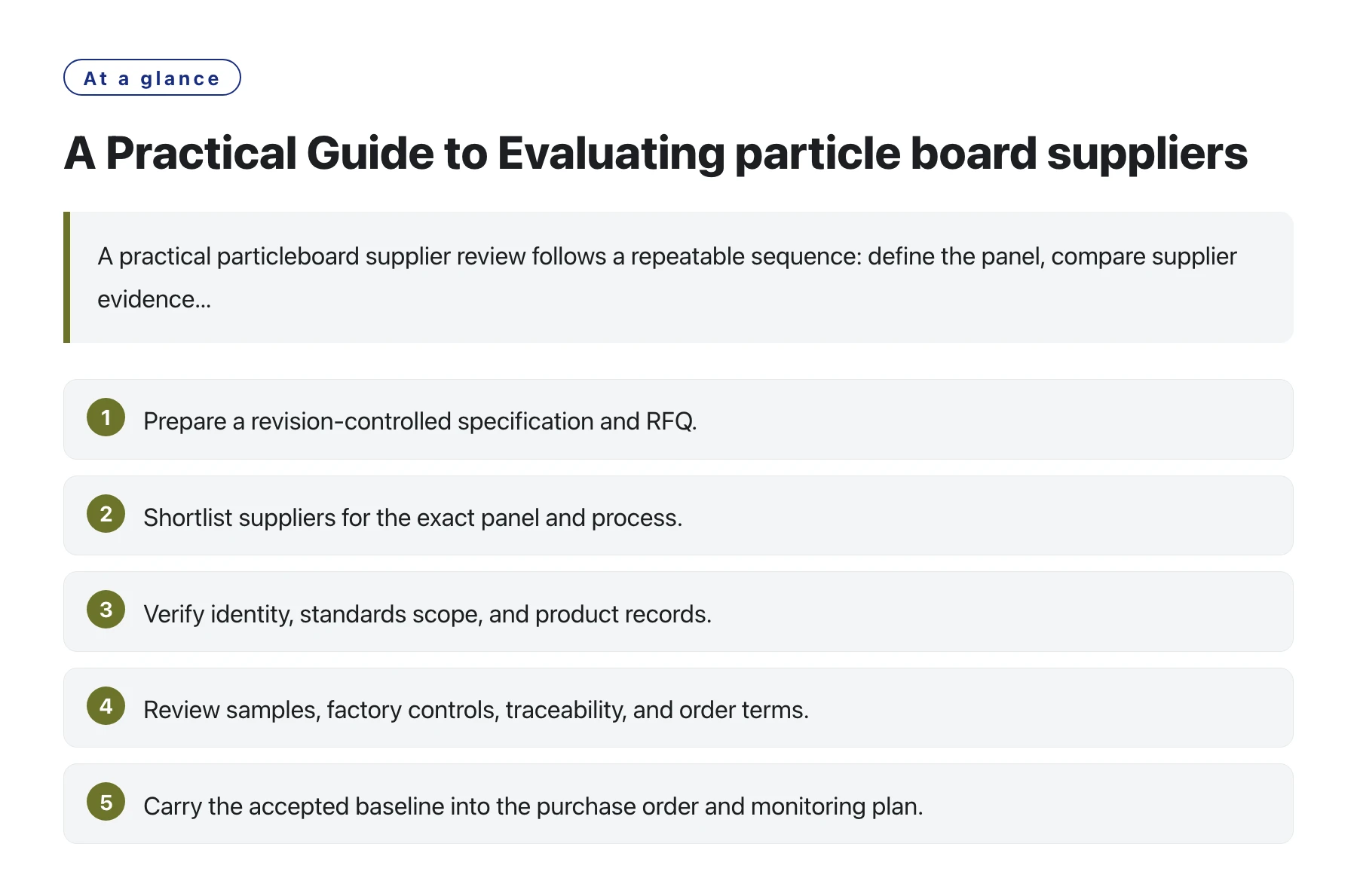
Key takeawaysPrepare a revision-controlled specification and RFQ. · Shortlist suppliers for the exact panel and process. · Verify identity, standards scope, and product records. · Review samples, factory controls, traceability, and order terms. · Carry the accepted baseline into the purchase order and monitoring plan.
Supplier evaluation continues after a quote arrives. A clear evidence path connects the panel, factory, sample, test results, shipment, and later corrective action.
1. Write the buying specification before searching
A supplier evaluation starts with a panel specification, not a list of factory names. Define use, dimensions, thickness, tolerances, surface, edge treatment, quantity, packaging, destination, delivery timing, and any market or project evidence requirements. Mark which fields are fixed and where a supplier may propose an alternative.
Add a clear statement of the assembly and process that follow delivery: cutting, drilling, laminating, painting, edge sealing, or load-bearing use. Ask the project designer to set any performance or design values. This makes later supplier answers comparable and prevents broad phrases such as “furniture grade” from standing in for a requirement.
2. Build a shortlist using relevant capability
Identify candidate producers through more than one channel and record why each appears relevant. Ask whether the quoted factory makes particleboard or buys and resells panels, and whether lamination, sanding, or cut-to-size service is performed at that facility. A trading partner may still fit the purchase, but its role and evidence path should be clear.
Screen on the product families, thickness range, finish capability, order quantity, export experience, and ability to provide the records required by the project. Remove candidates who cannot answer basic scope questions or who offer a generic product unrelated to the specified use. Keep unresolved points on a dated shortlist.
3. Confirm identity and contractual accountability
Verify the contracting entity, production site, invoice name, payment beneficiary, authorized contacts, and any exporter or intermediary relationship. Ask which party controls product changes, quality release, traceability, warranty, and replacement. Match these responsibilities to the order terms rather than assuming the seller and producer are the same.
Check business details through proportionate independent sources and confirm payment changes using a previously verified contact. Record verification date and evidence. These checks support commercial diligence but do not establish technical performance or guarantee supplier continuity.
4. Send a response matrix with the RFQ
Request that each bidder respond requirement by requirement with offered value, evidence, deviation, and comment. Ask for product designation, thickness, tolerances, dimensions, surface, finish code, lot identification, lead time, minimum order, price breaks, and packaging. Require explicit “not offered” or “exception” responses instead of blank cells.
Ask suppliers to attach technical data sheets, test records, sample photos, and the name of the factory and product line. Request separate prices for options and value-added work. Use one revision and deadline for all bidders, then distribute clarifications to every candidate so they are evaluated against the same information.
5. Evaluate standards and documentation scope
ISO 16893:2016 describes particleboard classifications, related tests, thickness ranges, and manufacturing property requirements for stated categories; its values are not design values. A qualified technical owner should determine whether this reference fits the end use and what other project or market requirements apply. [1]
Check that each declaration or report covers the named manufacturer, site, product, thickness, finish if relevant, test method, and date. Ask how a certificate or report maps to the item code in the supplier’s quote. A document for a broad product family may not cover a custom finish or a different plant.
6. Review samples against downstream operations
Select samples that represent the quoted panel and manufacturing route. Record dimensions, face and back, thickness, finish, edge, batch, and date. Review appearance under suitable lighting, then test machining or lamination compatibility where those operations are important. Compare results to written limits rather than a general impression.
Define what sample approval means: color reference, dimensional check, machining trial, or full construction approval. Retain the approved sample or controlled images and specify how routine production will be inspected. If the sample is hand-selected, treat it as a design reference rather than proof of lot-wide consistency.
7. Check factory controls and traceability
Ask how raw inputs are received and identified, how process changes are controlled, and how production lots connect to test results and shipping bundles. Review inspection frequency, measuring equipment where relevant, nonconforming material segregation, corrective action, and complaint handling. Request an example record with confidential customer information removed.
If key operations are outsourced, confirm the subcontractor, process scope, records, and approval route for changes. Trace one finished bundle through production date, product identification, inspection status, label, and packing list. Traceability enables a focused response if the buyer later finds a defect or mix-up.
8. Assess order fit and commercial conditions
Compare minimum order, production capacity, lead time, payment terms, quote validity, currency, sample cost, tooling, packaging, replacement policy, and delivery basis. Ask which assumptions depend on raw material availability, panel thickness, custom size, or finish. Separate an estimated delivery date from a firm commitment and identify its trigger.
Include costs for protective packing, cutting loss, inspection, freight, receiving, and expected sorting if they materially affect the project. Review how the supplier handles a shortage, nonconformity, late delivery, or damaged load. Do not accept an undefined “claim window”; link reporting deadlines to shipment receipt and inspection opportunity.
9. Run a proportionate trial and close gaps
Where production fit is uncertain, consider a bounded trial with an agreed quantity, sample method, acceptance criteria, packing specification, and review meeting. Set in advance what would permit scale-up and what would require correction. A trial is optional when requirements and process capability are already well understood.
Track unresolved questions with owner, evidence required, due date, and risk. Keep mandatory gates for product fit, identity, and required documentation separate from softer preferences such as response speed or quote format. Obtain authorized approval for any exception before placing a larger order.
10. Monitor supply after award
Attach the final specification, quote revision, approved sample, test scope, packaging instructions, and change rules to the purchase order. Establish a contact for technical questions and require notice before a site, process, material, finish, or subcontractor changes. Define how replacement or reinspection is handled.
Buyers working with JS Sourcing can use this process to organize supplier discovery, compare particleboard offers, and preserve a clear evidence trail. Confirm service scope directly, retain qualified technical approval, and review supplier performance after receipt before repeating the order.
Sources
Frequently asked questions
What is the first step in evaluating a particleboard supplier?
Define panel use, dimensions, finish, order profile, destination, and evidence requirements before building a shortlist.
Does a supplier data sheet replace a test report?
Not always. Match each claim to product-specific evidence and decide which tests or declarations the project requires.
Should I visit every panel supplier?
Choose verification depth based on order risk, evidence gaps, site claims, and the importance of direct process observation.
What should be attached to the purchase order?
Attach the approved specification, quote revision, sample record, packaging requirements, evidence list, and change-control terms.