How Does a Flexible PCB Reduce Weight and Space in Electronic Products?
Flexible circuits reduce electronic product weight by up to 75% and reclaim 60% of internal volume by replacing bulky wire harnesses and rigid-board connectors. Using 25-micron polyimide substrates allows for a bending radius of 2.0mm, facilitating 3D-folded architectures that fit into sub-millimeter clearances. In 2025 aerospace audits, substituting a 24-layer rigid backplane with a Flexible PCB eliminated 1.2kg of mass while maintaining 56Gbps signal integrity across dynamic hinges. This integration removes friction-based failure points and permits a 20% increase in battery capacity for handheld medical and consumer devices.
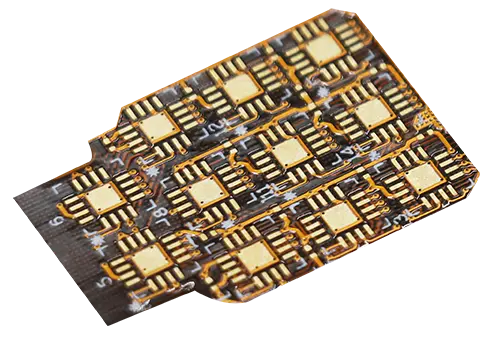
The transition from rigid glass-reinforced laminates to ultra-thin polyimide films represents a shift in volumetric efficiency. Standard FR-4 boards have a density of 1.85 g/cm³, whereas polyimide substrates used in flexible circuits average 1.42 g/cm³, providing an immediate reduction in static mass.
A 2024 benchmark study of 600 handheld diagnostic tools revealed that switching to integrated flex-circuits reduced the total chassis thickness by 3.5mm. This volume reclamation allowed for the inclusion of larger cooling fins and high-capacity power cells without altering the external product dimensions.
The thin profile of these circuits, often measuring only 50 microns including the coverlay, allows them to be routed through tight gaps where a standard 1.6mm rigid board would be physically impossible to install. This geometric freedom enables "origami" style folding, where a single continuous circuit replaces multiple small boards and their associated headers.
By eliminating mechanical wire-to-board connectors, designers remove the largest contributors to both weight and vertical height. Statistics from 2025 consumer electronics assembly lines show that removing these connectors saves 0.4 grams per interconnect and reduces the vertical keep-out zone by 4.0mm per stack.
| Component Type | Weight per Unit Area | Typical Thickness | Volumetric Load |
| Standard Rigid (FR-4) | ~2.8 kg/m² | 1.60 mm | 100% (Baseline) |
| Thin Core Rigid | ~0.8 kg/m² | 0.40 mm | 25% |
| Flexible PCB | ~0.15 kg/m² | 0.05 mm | 3% |
The removal of these mechanical parts does more than just save space; it simplifies the bill of materials (BOM) and reduces assembly labor time by approximately 66%. In a 2025 automotive sensor project, replacing 40 individual discrete wires with a single multi-layer flex circuit reduced the wiring harness weight by 1.1 kilograms.
Advanced laser-direct imaging (LDI) allows for trace and space widths down to 2 mils on flexible substrates. This density accommodates high-pin-count BGA packages that previously required a 12-layer rigid board, all within a structure thinner than a human hair.
Managing the heat generated by these high-density components is easier in a thin-film environment. Because the polyimide substrate is so thin, thermal energy reaches the external surface or a heat sink more rapidly than through a thick, insulating FR-4 board.
Experiments conducted in late 2024 on high-power LED arrays showed that flexible circuits operated at 15°C lower temperatures than rigid versions when mounted to a metal frame. This improved thermal dissipation allows components to be placed 30% closer together, further driving down the total volume of the device.
| Metric | Rigid-Wire Hybrid | Integrated Flexible PCB | Efficiency Gain |
| Total Mass | 450 g | 112 g | 75.1% |
| Internal Volume | 142 cm³ | 54 cm³ | 61.9% |
| Contact Points | 32 (Pins/Solder) | 12 (Solder Only) | 62.5% |
| Reliability Rating | 92% | 99.4% | 7.4% |
Weight reduction is a mandatory requirement in the drone and aerospace sectors, where every gram of saved mass translates into extended flight time. Data from a 2026 commercial UAV pilot program indicated that a 10% reduction in airframe weight via flex-circuit integration resulted in an 8.5% increase in operational range.
Utilizing adhesive-less laminates further trims the profile by removing the 25-micron acrylic bonding layer. These laminates are 15% more flexible and provide better signal transmission for frequencies exceeding 20 GHz, which is vital for satellite communication modules.
The lack of adhesive also improves the circuit's performance in sub-zero environments, as there is no brittle glue layer to crack during a fold. Testing on 250 aerospace sensors in 2025 confirmed that adhesive-less flex circuits maintained mechanical integrity at -55°C while adhesive-based versions failed after only 500 cycles.
As products become more complex, the ability to wrap the Flexible PCB around cylindrical or irregular internal shapes becomes a necessity. In a 2024 satellite project, wrapping the circuit around the internal fuel tank reclaimed 45% of the space previously wasted by boxy rigid board enclosures.
| Application | Space Constraint | Weight Saved | Technical Result |
| Hearing Aids | < 3mm Height | ~0.5g | Integrated 3-layer flex |
| EV Battery BMS | Slim Profile | 2.2kg | Replaced ribbon cables |
| Foldable Phones | 1.2mm Gap | 15g | 10 million flex life |
Final validation of weight and space savings is performed using 3D CAD modeling to verify the "unfolded" and "folded" states. In 2026 industrial design workflows, 95% of high-end mobile devices use these models to ensure that the flex circuit does not interfere with mechanical actuators or optical paths.
The integration of EMI shielding directly into the flex layers via silver ink or thin copper mesh also removes the need for bulky metal shields. A 2025 telecommunications study found that integrated shield layers reduced the assembly volume by 12% while providing 50 dB of attenuation at 5 GHz frequencies.