Thinking of Moving Pools? What the Pool Dashboard Tells You First
Pool output at any hashrate is fixed by network arithmetic: 100 TH/s earns about 0.00004486 BTC a day, so 0.05 BTC takes 1114.6 days, while 1 PH/s shortens the same target to 111.5 days. Before pointing miners at a new pool, read its hashrate, luck and fee pages the way this guide describes. The switch itself is quick; the due diligence is what protects your revenue.

Key takeaways
- At 100 TH/s the daily credit is about 0.00004486 BTC, so 0.05 BTC needs 1114.6 days at current difficulty.
- At 1 PH/s the same 0.05 BTC target needs 111.5 days, exactly one tenth of the time.
- Pool Luck swings around the mean while the listed fee stays put, so model fees first and luck second.
- PPS+ settles hourly against current difficulty; PPLNS pays after 6 confirmations across the last 5 difficulty rounds.
Your coins come from shares, not from the logo
A pool never manufactures yield; it divides the network's fixed 450 BTC a day among contributors by valid shares. With the network near 1,003 EH/s and difficulty at 132.76 T, each terahash earns roughly 0.0000004487 BTC daily before fees. Multiply by your terahash and you hold the gross line no pool page can improve, because the subsidy of 3.125 BTC per block times 144 blocks is the same for everyone.
What a pool does control is smaller but real: how continuously it finds blocks, how fast it credits your share and what fraction it keeps. Those three show up as Pool Hashrate, Pool Luck and the fee schedule. A pool with steady blocks and prompt settlement turns your arithmetic into spendable coins with less wobble, even though it cannot change the daily totals.
Reading the hashrate curve like a capacity gauge
The ViaBTC Pool Hashrate display reports how much work is currently pointed at the pool. Read it as a capacity gauge: a large, stable series means blocks arrive in a smooth stream and per-miner variance stays modest, while a thin or jumpy series means longer gaps between found blocks. Your own daily expectation does not move with that gauge, but the rhythm of arrivals does.
Pair the gauge with the miner count and the network total when both are shown. If pool hashrate climbs while yours is flat, your slice of each block thins even as blocks come faster — the two effects roughly cancel for PPS+ miners, which is the point of that mode. For PPLNS miners the same move changes window shares, so the gauge deserves a second look before switching modes.
Luck evens out while fee math stays put
Pool Luck compares blocks actually found against the statistical expectation over a window. Values above or below the mean look dramatic on short windows and fade toward average as the window lengthens. Treat a lucky week as noise and an unlucky month as weather: worth noticing, never worth chasing by hopping pools every few days, since each hop resets your PPLNS window position.
Fees behave the opposite way. PPS+ lists 4% on the PPS-settled block-reward component and 2% on the fee component; PPLNS lists 2% on the combined reward. Those deductions apply every single day, lucky or not. A pool with average luck and a lower applicable rate beats a lucky pool with a heavier one across any horizon that matters, which is why the fee schedule belongs ahead of the luck chart in your comparison.
How long until 0.05 BTC at your size
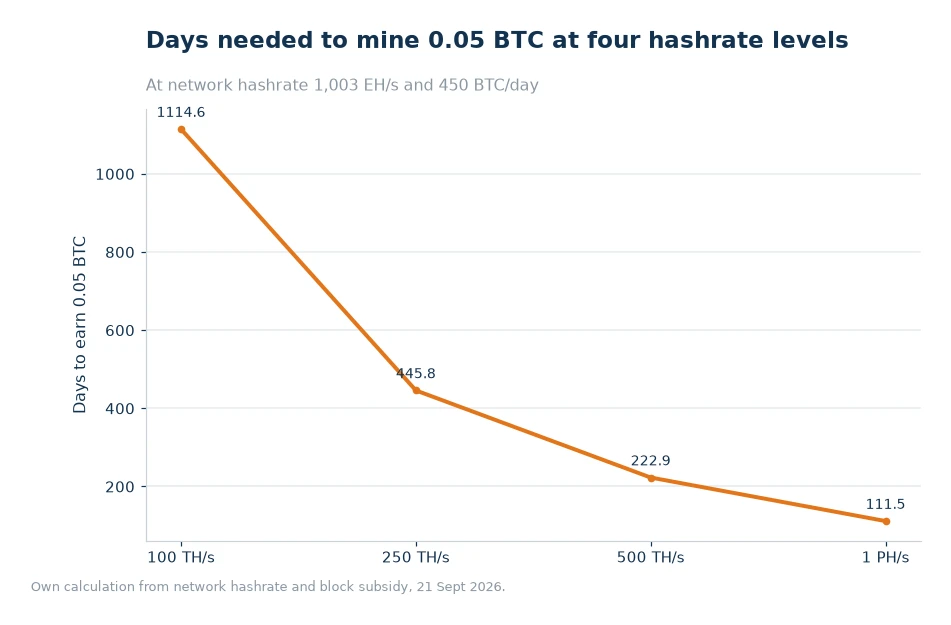
Time-to-target turns abstract daily rates into calendar language. Divide 0.05 BTC by your daily coins and the quotient is the wait in days at constant difficulty. The table below runs that division at four common sizes, from a single 100 TH/s unit to a 1 PH/s shelf. Difficulty was read at 132.76 T with BTC at $84,692, and the arithmetic uses the gross rate so every pool starts from the same line.
| Hashrate | BTC per day | Days to 0.05 BTC | About (months) |
|---|---|---|---|
| 100 TH/s | 0.00004486 | 1114.6 | 36.6 |
| 250 TH/s | 0.00011215 | 445.8 | 14.6 |
| 500 TH/s | 0.00022433 | 222.9 | 7.3 |
| 1 PH/s | 0.00044866 | 111.5 | 3.7 |
The halving pattern is exact: doubling hashrate halves the wait. That proportionality is what makes the table portable — a 200 TH/s setup waits roughly twice the 100 TH/s row divided by two, about 557 days. Use your own terahash in the same division whenever your fleet sits between the printed rows.
The switch checklist before you point miners over
Switching means new stratum URLs, new worker names and a payout address review, in that order. Copy the address character by character and send a tiny test settlement first where the pool supports it. Confirm the fee mode selected on the account matches the one you modelled — PPS+ is the default, and an account left on the other mode will settle on a different schedule than you expect.
Stagger the move if you run more than a couple of units. Point one machine over, watch its reported hashrate converge with its local reading over a few hours, then migrate the rest. Keep the old pool account open until the final settlement lands; PPLNS tails in particular can dribble in after the machines have left. A checklist beats memory at midnight when fans are loud and patience is thin.
After the move: the two lines to watch
For the first week, compare the pool's reported hashrate for your workers against what the machines claim locally. A persistent gap beyond a few percent points at rejected shares, firmware issues or network loss between your site and the nearest node. The pool's Statistics views and the daily credit line together tell you whether the gap costs money or is merely display lag.
Second, track the credit cadence the mode promises. Under PPS+ you should see hourly settlement against current difficulty; under PPLNS, payment follows after 6 confirmations with shares weighted over the last 5 difficulty rounds. Either pattern, once confirmed for a few days, becomes your baseline. Deviations from baseline are then easy to spot, and the Profit Calculator gives you the expected daily figure to hold the baseline against.
Worked example
Follow the 100 TH/s row from network totals to the 1114.6-day figure.
- Daily network pool: 144 blocks × 3.125 BTC = 450 BTC.
- Network hashrate: 1,003 EH/s = 1,003,000,000 TH/s.
- Daily BTC per TH/s: 450 ÷ 1,003,000,000 = 0.0000004487 (about 4.5e-07).
- At 100 TH/s: 100 × 0.0000004487 = 0.00004486 BTC a day (4.486e-05).
- Days to 0.05 BTC: 0.05 ÷ 0.00004486 = 1114.6 days.
- At 250 TH/s: 0.00011215 BTC a day, so 0.05 ÷ 0.00011215 = 445.8 days.
- At 500 TH/s: 0.00022433 BTC a day, so 0.05 ÷ 0.00022433 = 222.9 days.
- At 1 PH/s (1,000 TH/s): 0.00044866 BTC a day, so 0.05 ÷ 0.00044866 = 111.5 days.
Frequently asked questions
How long does 100 TH/s need for 0.05 BTC?
About 1114.6 days at current difficulty, since 100 TH/s earns roughly 0.00004486 BTC a day and 0.05 divided by that rate gives 1114.6.
Does a bigger pool get me coins faster?
No. Your daily expectation follows your share of the 1,003 EH/s network total; a larger Pool Hashrate smooths block arrivals and a steadier Pool Luck line, but neither changes the per-terahash rate.
Which settles first after I switch, PPS+ or PPLNS?
PPS+ credits hourly against current difficulty, while PPLNS pays after 6 confirmations with your slice weighted over the last 5 difficulty rounds, so the first PPLNS payment naturally trails the first PPS+ one.
Move once, on evidence
A good switch reads like this: the fee schedule fits your mode, the hashrate series looks stable, luck sits near its mean and your time-to-target at current difficulty is acceptable. When all four check out, move one machine, verify the credit line for a day, then move the fleet. That sequence takes an evening and removes almost every expensive surprise.
Keep this guide's table taped to the decision. If the numbers say 0.05 BTC needs 445.8 days at your 250 TH/s, no dashboard color scheme shortens it — only more terahash, lower fees or kinder difficulty can. Choose the pool that disturbs the arithmetic least, then let the machines do the waiting.
Sources: the ViaBTC pool state and fee pages for hashrate display, Pool Luck and the listed PPS+ and PPLNS rates[1]. Chain inputs read 21 Sept 2026: network hashrate 1,003 EH/s, difficulty 132.76 T, subsidy 3.125 BTC per block, 144 blocks a day, BTC $84,692. Published 11 Nov 2026; day counts are arithmetic on those inputs and assume continuous uptime.